Whole life insurance
Lifetime coverage, guaranteed premiums and a cash value that grows over time.
In brief
Whole life insurance
Some needs do not fade with age. The tax owed at death on a cottage or an RRSP, the wish to leave something to your grandchildren, the protection of a child with a disability: these needs are still there at 80 or 90. Whole life insurance was designed for them.
How it works
You pay a level premium for a chosen period (for example to age 100, for 20 years or for 10 years) or for life. In exchange, the insurer guarantees a death benefit, whatever your age.
Part of the premiums builds a guaranteed cash value that grows every year. In a participating policy, the insurer may also pay dividends, depending on the results of its participating account. These dividends can buy paid-up additions, which increase both the death benefit and the cash value.
The advantages
Nothing left to chance
Premium, death benefit and base cash value are guaranteed by contract.
Coverage that never stops
No costly renewals, no age limit.
Cash when the estate needs it
The benefit arrives exactly when needed: to pay the tax on a cottage, an RRSP or a business, without a fire sale.
A reserve you can use while living
The cash value can secure a loan or be withdrawn, depending on the policy.
Who is it for?
- Parents of a lifelong dependent child
- To provide for a child with a disability, often through a trust.
- Owners of a cottage or rental property
- The capital gain is taxable at death. The benefit pays the tax and the family keeps the property.
- Grandparents
- To leave a specific legacy, known in advance, to their grandchildren.
- Business owners
- A policy owned by the corporation can, under certain conditions, allow the benefit to be paid to shareholders partly tax-free through the capital dividend account.
A real-life example
Pierre, 58, owns a cottage in Charlevoix bought twenty-five years ago. At his death, the gain will be taxable and his children will have to find the money to pay the tax.
A whole life policy with premiums payable for 20 years will provide a tax-free benefit at the very moment the tax becomes due. The children will not have to sell the cottage in a hurry to pay the bill.
The options available
| Participating | Dividends are not guaranteed, but potentially significant over the long term. |
|---|---|
| Non-participating | Everything is guaranteed, often at a lower premium, but with no additional growth. |
| Limited pay (10 or 20 years) | Higher premiums, but finished before retirement. |
| Joint last-to-die whole life | An economical way to pay the tax that becomes due at the death of the second spouse. |
Key terms
| Cash value | The amount you would receive if you cancelled the policy. You can also borrow against it or use it as collateral. |
|---|---|
| Dividends | The share of the participating account's results paid to policyholders. They are never guaranteed and vary from year to year. |
| Paid-up additions | Extra coverage bought with dividends, with no new medical evidence. |
| Limited pay | Premiums stop after 10 or 20 years, or at a set age, but coverage continues for life. |
| Policy loan | A loan from the insurer against the cash value. It reduces the death benefit until it is repaid. |
What to watch for
- Dividends are not guaranteed: an illustration is only an assumption. Ask to see the scenario with a reduced dividend scale.
- Cancelling early is costly: the cash value is low in the first years.
- An unpaid policy loan reduces the benefit paid at death.
- The right amount: too much coverage strains the budget for nothing. Start from the real need.
The right questions to ask
- Is my need truly permanent?
- Participating or not, in my situation?
- What happens if dividends go down?
- Should the policy belong to me or to my corporation?
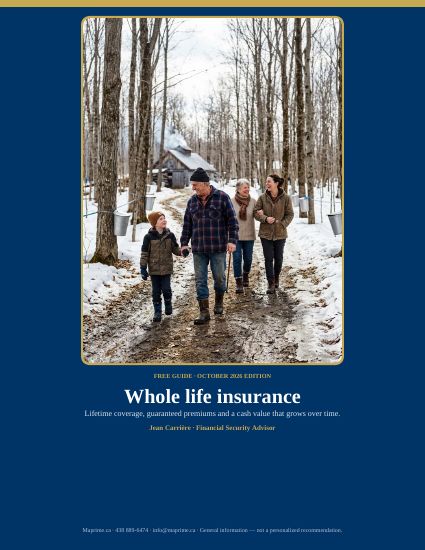
The complete guide, free
Everything you need to know, illustrated and explained in plain language, with a worked example and the pitfalls to avoid. No sign-up or email required.
Let's talk about your situation
A 30-minute meeting, in person in Montreal, by Google Meet or by phone. I compare the products of several insurers, at no cost and with no obligation.
Other protections







Sources :
- Income Tax Act (deemed disposition at death, capital dividend account)
- Civil Code of Québec, art. 2449
- Standard contracts of Canadian insurers, reviewed in October 2026
General information: this content is not personalized advice. Guarantees, exclusions and premiums are those of the insurer's contract. Images: Pexels photographs (Pexels licence) and illustrations generated by artificial intelligence; the people shown are models or fictional characters.