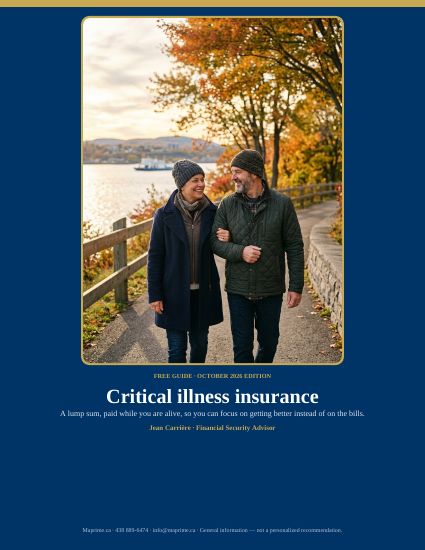
Critical illness insurance
A lump sum, paid while you are alive, so you can focus on getting better instead of on the bills.
In brief
Critical illness insurance
Today, many people survive cancer, heart attacks and strokes. That is wonderful news, but recovery is expensive: months off work, a spouse who takes time off to be with you, medication or care the public plan does not cover. Critical illness insurance pays a sum of money at the moment you need it most.
How it works
If you are diagnosed with a covered illness, such as a life-threatening cancer, a heart attack or a stroke, and you survive the period set in the contract, the insurer pays you the chosen amount in a single payment.
Policies range from a few core illnesses to more than twenty conditions. The definitions largely follow those recommended by the industry, but each insurer has its own particulars: that is where comparing really pays off.
The advantages
Money when life turns upside down
The benefit arrives during the illness, not after death.
No receipts required
You do not have to show bills: the money is yours.
A complement to disability coverage
Disability replaces a monthly income; critical illness covers unexpected costs and treatment choices.
Return of premium
With that option, you can get your premiums back if you never fall ill.
Who is it for?
- Parents of young children
- To keep the home and daily life stable during treatment.
- The self-employed
- To replace income that stops abruptly.
- People with a family history
- Applying early, while you are healthy, is essential.
- Two-income couples
- So one spouse can take time off work to support the other.
A real-life example
Nathalie, 47, an accountant in Québec City, is diagnosed with breast cancer. Her employer keeps paying part of her salary, but she has to be away for almost a year and her spouse cuts his hours to be with her.
One month after the diagnosis, her critical illness policy pays her $75,000 in a single, non-taxable payment. She pays off her line of credit, pays for a treatment that is not covered and takes the time to heal without worrying about the bank account.
The options available
| Basic or extended coverage | From a few major illnesses to more than twenty conditions. |
|---|---|
| Term, to age 75 or lifetime | Depending on the need and the budget. |
| Return of premium at death or expiry | To get back all or part of the premiums paid. |
| Children's coverage | Policies designed for childhood illnesses, convertible in adulthood. |
Key terms
| Benefit amount | The amount paid, for example $25,000, $50,000 or $100,000. |
|---|---|
| Covered illnesses | The list and exact definitions are in the contract. The number varies by product. |
| Survival period | The minimum time between diagnosis and payment, usually 30 days. |
| Partial benefit | A reduced amount for some less severe conditions, such as an early-stage cancer, depending on the policy. |
| Exclusion period | Some illnesses, such as cancer, are not covered if symptoms appear in the first 90 days. |
What to watch for
- The illness definitions: two policies that cover "25 illnesses" can be very different.
- The 90-day exclusion period for some cancers.
- Personal or family medical history declared on the application.
- The cost of the return-of-premium option, compared with the value it provides.
The right questions to ask
- Which illnesses are covered, and under what definitions?
- What amount would let me breathe for a year?
- Is the return-of-premium option worth its cost for me?
- How does this coverage fit with my disability insurance?
The complete guide, free
Everything you need to know, illustrated and explained in plain language, with a worked example and the pitfalls to avoid. No sign-up or email required.
Let's talk about your situation
A 30-minute meeting, in person in Montreal, by Google Meet or by phone. I compare the products of several insurers, at no cost and with no obligation.
Other protections







Sources :
- Canadian Life and Health Insurance Association (CLHIA), recommended minimum definitions
- Standard contracts of Canadian insurers, reviewed in October 2026
General information: this content is not personalized advice. Guarantees, exclusions and premiums are those of the insurer's contract. Images: Pexels photographs (Pexels licence) and illustrations generated by artificial intelligence; the people shown are models or fictional characters.