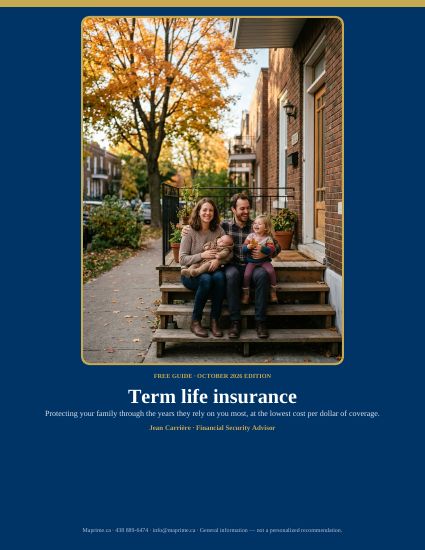
Term life insurance
Protecting your family through the years they rely on you most, at the lowest cost per dollar of coverage.
In brief
Term life insurance
People rarely buy term life insurance out of enthusiasm. They buy it the day they sign a mortgage, bring a baby home or realize the household runs on two paycheques. It is protection designed for a specific period: the years when a death would leave your loved ones with debts, children to raise and one income less.
How it works
You choose an amount, say $500,000, and a term, say 20 years. As long as the premiums are paid, the insurer promises to pay that amount to your beneficiary if you die during the term. If you are still here at the end, the policy renews at a higher premium or ends, as you prefer.
There is no cash value: you pay for protection only. That is exactly what makes it affordable.
The advantages
A lot of coverage for little money
For a young family, it is often the only way to get enough coverage without squeezing the budget.
A predictable premium
It does not move for the whole term. You know what you will pay fifteen years from now.
The benefit is tax-free
Your family receives the full amount, quickly, without waiting for the estate to be settled when a beneficiary is named.
A door left open
If your health changes, the conversion right lets you keep lifetime coverage with no new exam.
Who is it for?
- The young family
- Two incomes, a mortgage, small children. The benefit replaces lost income and pays off debts.
- The new homeowner
- Coverage that follows the mortgage, belongs to you and stays with you if you change lenders.
- The self-employed
- The income disappears with you. Term protects those who depend on it during the growth years.
- Business partners
- To fund a shareholder buy-sell agreement for a defined period.
A real-life example
Julie and Marc, 34 and 36, have two children aged 2 and 5 and a $380,000 mortgage. Marc earns $72,000 a year.
Running the numbers, we add up the mortgage, five years of Marc's income to give the family time, and an amount for the children's education. The need comes to about $800,000. A 20-year term covers the years when the children are dependent and the mortgage weighs the most.
In twenty years, the mortgage will be almost paid off, the children will be adults and savings will have taken over. The need for insurance will have melted away, which is exactly what term insurance plans for.
The options available
| 10, 20 or 30-year term | Choose the term that matches the need: the end of the mortgage, the children's independence, retirement. |
|---|---|
| Term to 65 | A level premium until retirement, for those who want to settle the question once. |
| Joint coverage | One policy on two lives, payable at the first death. Often cheaper than two policies, but less flexible. |
| Child rider | A small amount of coverage on each child, convertible later with no medical evidence. |
| Waiver of premium | If you become disabled, the insurer pays the premiums for you. |
Key terms
| Face amount | The amount paid at death. It is tax-free for the beneficiary. |
|---|---|
| Term | The period during which the premium is guaranteed: 10, 20 or 30 years, or to age 65 depending on the product. |
| Renewal | At the end of the term, the policy can renew without medical evidence, at a higher premium, up to the age set in the contract. |
| Conversion | The right to change term into permanent insurance with no medical exam, before an age limit set in the contract. |
| Beneficiary | The person who receives the benefit. In Québec, naming a married or civil union spouse is irrevocable unless the contract says otherwise. |
What to watch for
- The renewal cost: the premium rises sharply at the end of each term. Choose a term that covers the whole need rather than one that is too short.
- The conversion deadline: past that age, the right to go permanent disappears.
- The health questionnaire: an inaccurate answer can allow the insurer to cancel the policy in the first two years.
- Group insurance through your employer: it ends if you leave your job. It complements personal coverage; it does not replace it.
The right questions to ask
- How much would my family need, with real numbers?
- Which term truly matches my obligations?
- Until what age can I convert this policy?
- What will renewal cost at the end of the term?
The complete guide, free
Everything you need to know, illustrated and explained in plain language, with a worked example and the pitfalls to avoid. No sign-up or email required.
Let's talk about your situation
A 30-minute meeting, in person in Montreal, by Google Meet or by phone. I compare the products of several insurers, at no cost and with no obligation.
Other protections







Sources :
- Civil Code of Québec, art. 2449 (irrevocable designation of a spouse)
- Income Tax Act (life insurance death benefits not taxable)
- Standard contracts of Canadian insurers, reviewed in October 2026
General information: this content is not personalized advice. Guarantees, exclusions and premiums are those of the insurer's contract. Images: Pexels photographs (Pexels licence) and illustrations generated by artificial intelligence; the people shown are models or fictional characters.