Long-term care insurance
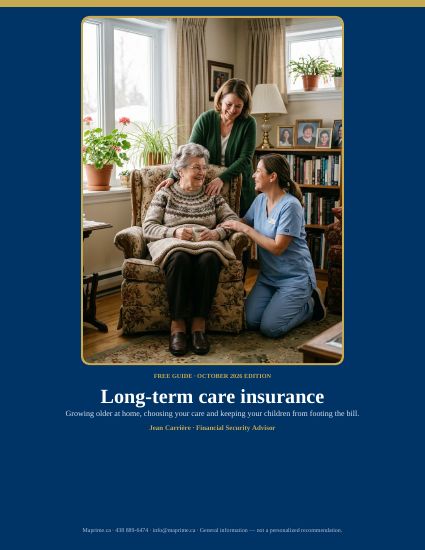
Growing older at home, choosing your care and keeping your children from footing the bill.
In brief
Long-term care insurance
Most of us hope to grow old at home. Yet a few hours of help a day, a care service or a place in a private seniors' residence quickly cost several thousand dollars a month. Often it is the children who make up the difference, in money or in time. Long-term care insurance plans for that moment.
How it works
When a health professional confirms that you can no longer perform certain activities of daily living on your own (bathing, dressing, eating, moving around, toileting, continence) or that you have a cognitive impairment such as Alzheimer's, and once the waiting period has passed, the insurer pays a benefit.
Depending on the policy, the benefit is a fixed amount, whatever the actual expenses, or it reimburses eligible costs up to a ceiling. It can be paid for a set period or for life.
The advantages
Staying home longer
The benefit pays for the help needed to live in your own surroundings.
Choosing where and how you are cared for
A private residence, home care: the decision is yours.
Protecting your children
They stay your children, not your financial caregivers.
Preserving the inheritance
A lifetime of savings is not swallowed up by housing and care costs.
Who is it for?
- Healthy people aged 45 to 65
- The age when coverage is accessible and affordable.
- People without children or far from family
- Who will not be able to count on a family caregiver.
- Couples who want to protect each other
- So that one spouse's care does not impoverish the other.
- Adult children
- Who want to buy coverage for their parents and plan for the costs.
A real-life example
Louise, 81, a widow, lives alone in her condo in Sherbrooke. After a fall and early memory problems, she needs help bathing and dressing.
Her policy pays her a fixed monthly benefit. She pays for a home care worker every morning and can stay in her own home. Her two daughters visit because they enjoy it, not because they have no choice.
The options available
| Benefit period | Two years, five years or for life. |
|---|---|
| Benefit amount | Chosen according to the cost of care in your region. |
| Indexation | So the benefit keeps pace with inflation. |
| Limited-pay premiums | To finish paying premiums before retirement. |
Key terms
| Activities of daily living | The basics: bathing, dressing, eating, moving around, toileting, continence. |
|---|---|
| Cognitive impairment | A decline in mental abilities, such as Alzheimer's disease, that requires supervision. |
| Waiting period | The period of lost independence before the first payment, often 90 days. |
| Income-style benefit | A fixed amount paid without requiring receipts. |
| Reimbursement benefit | Repayment of eligible costs actually incurred, up to a maximum. |
What to watch for
- The triggers: how many activities of daily living must be affected.
- The waiting period and the maximum benefit period.
- Whether premiums can increase, depending on the contract.
- Limited availability in Canada: few insurers still offer this product on an individual basis. Compare carefully.
The right questions to ask
- What do home care and residences cost in my region?
- What criteria trigger the benefit?
- Can the premiums go up?
- Would critical illness insurance with loss-of-independence coverage be a better fit?
The complete guide, free
Everything you need to know, illustrated and explained in plain language, with a worked example and the pitfalls to avoid. No sign-up or email required.
Let's talk about your situation
A 30-minute meeting, in person in Montreal, by Google Meet or by phone. I compare the products of several insurers, at no cost and with no obligation.
Other protections







Sources :
- Standard contracts of Canadian insurers, reviewed in October 2026
- Government of Québec, tax credit for home-support services for seniors (general information)
General information: this content is not personalized advice. Guarantees, exclusions and premiums are those of the insurer's contract. Images: Pexels photographs (Pexels licence) and illustrations generated by artificial intelligence; the people shown are models or fictional characters.